Free Web space and hosting from freehomepage.com
Search the Web

THE PRINCESS AND THE GOBLIN by GEORGE MACDONALD Select Background & Text
   http://go.to/web_books


The Princess and the Goblin

by George MacDonald


Illustrated by Jessie Willcox Smith
and Arthur Hughes


The Princess & The Goblin


CHAPTER 16
The Ring


    The same moment her nurse came into the room, sobbing. When she saw her sitting there she started back with a loud cry of amazement and joy. Then running to her, she caught her in her arms and covered her with kisses.
    'My precious darling princess! where have you been? What has happened to you? We've all been crying our eyes out, and searching the house from top to bottom for you.'
    'Not quite from the top,' thought Irene to herself; and she might have added, 'not quite to the bottom', perhaps, if she had known all. But the one she would not, and the other she could not say. 'Oh, Lootie! I've had such a dreadful adventure!' she replied, and told her all about the cat with the long legs, and how she ran out upon the mountain, and came back again. But she said nothing of her grandmother or her lamp.
    'And there we've been searching for you all over the house for more than an hour and a half!' exclaimed the nurse. 'But that's no matter, now we've got you! Only, princess, I must say,' she added, her mood changing, 'what you ought to have done was to call for your own Lootie to come and help you, instead of running out of the house, and up the mountain, in that wild, I must say, foolish fashion.'
    'Well, Lootie,' said Irene quietly, 'perhaps if you had a big cat, all legs, running at you, you might not exactly know what was the wisest thing to do at the moment.'
    'I wouldn't run up the mountain, anyhow,' returned Lootie.
    'Not if you had time to think about it. But when those creatures came at you that night on the mountain, you were so frightened yourself that you lost your way home.'
    This put a stop to Lootie's reproaches. She had been on the point of saying that the long-legged cat must have been a twilight fancy of the princess's, but the memory of the horrors of that night, and of the talking-to which the king had given her in consequence, prevented her from saying what after all she did not half believe - having a strong suspicion that the cat was a goblin; for she knew nothing of the difference between the goblins and their creatures: she counted them all just goblins.
    Without another word she went and got some fresh tea and bread and butter for the princess. Before she returned, the whole household, headed by the housekeeper, burst into the nursery to exult over their darling. The gentlemen-at-arms followed, and were ready enough to believe all she told them about the long-legged cat. Indeed, though wise enough to say nothing about it, they remembered, with no little horror, just such a creature amongst those they had surprised at their gambols upon the princess's lawn.
    In their own hearts they blamed themselves for not having kept better watch. And their captain gave orders that from this night the front door and all the windows on the ground floor should be locked immediately the sun set, and opened after upon no pretence whatever. The men-at-arms redoubled their vigilance, and for some time there was no further cause of alarm.
    When the princess woke the next morning, her nurse was bending over her. 'How your ring does glow this morning, princess! - just like a fiery rose!' she said.
    'Does it, Lootie?' returned Irene. 'Who gave me the ring, Lootie? I know I've had it a long time, but where did I get it? I don't remember.' 'I think it must have been your mother gave it you, princess; but really, for as long as you have worn it, I don't remember that ever I heard,' answered her nurse.
    'I will ask my king-papa the next time he comes,' said Irene.
   

CHAPTER 17
Springtime


    The spring so dear to all creatures, young and old, came at last, and before the first few days of it had gone, the king rode through its budding valleys to see his little daughter. He had been in a distant part of his dominions all the winter, for he was not in the habit of stopping in one great city, or of visiting only his favourite country houses, but he moved from place to place, that all his people might know him. Wherever he journeyed, he kept a constant look-out for the ablest and best men to put into office; and wherever he found himself mistaken, and those he had appointed incapable or unjust, he removed them at once. Hence you see it was his care of the people that kept him from seeing his princess so often as he would have liked. You may wonder why he did not take her about with him; but there were several reasons against his doing so, and I suspect her great-great-grandmother had had a principal hand in preventing it. Once more Irene heard the bugle-blast, and once more she was at the gate to meet her father as he rode up on his great white horse.
    After they had been alone for a little while, she thought of what she had resolved to ask him. 'Please, king-papa,' she said, 'Will you tell me where I got this pretty ring? I can't remember.'
    The king looked at it. A strange beautiful smile spread like sunshine over his face, and an answering smile, but at the same time a questioning one, spread like moonlight over Irene's. 'It was your queen-mamma's once,' he said.
    'And why isn't it hers now?' asked Irene.
    'She does not want it now,' said the king, looking grave.
    'Why doesn't she want it now?'
    'Because she's gone where all those rings are made.'
    'And when shall I see her?' asked the princess.
    'Not for some time yet,' answered the king, and the tears came into his eyes.
    Irene did not remember her mother and did not know why her father looked so, and why the tears came in his eyes; but she put her arms round his neck and kissed him, and asked no more questions.
    The king was much disturbed on hearing the report of the gentlemen-at-arms concerning the creatures they had seen; and I presume would have taken Irene with him that very day, but for what the presence of the ring on her finger assured him of. About an hour before he left, Irene saw him go up the old stair; and he did not come down again till they were just ready to start; and she thought with herself that he had been up to see the old lady. When he went away he left other six gentlemen behind him, that there might be six of them always on guard.
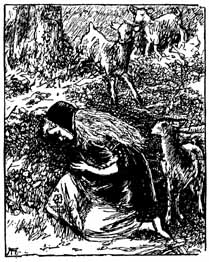
    And now, in the lovely spring weather, Irene was out on the mountain the greater part of the day. In the warmer hollows there were lovely primroses, and not so many that she ever got tired of them. As often as she saw a new one opening an eye of light in the blind earth, she would clap her hands with gladness, and unlike some children I know, instead of pulling it, would touch it as tenderly as if it had been a new baby, and, having made its acquaintance, would leave it as happy as she found it. She treated the plants on which they grew like birds' nests; every fresh flower was like a new little bird to her. She would pay visits to all the flower-nests she knew, remembering each by itself. She would go down on her hands and knees beside one and say: 'Good morning! Are you all smelling very sweet this morning? Good-bye!' and then she would go to another nest, and say the same. It was a favourite amusement with her. There were many flowers up and down, and she loved them all, but the primroses were her favourites.
    'They're not too shy, and they're not a bit forward,' she would say to Lootie. There were goats too about, over the mountain, and when the little kids came she was as pleased with them as with the flowers. The goats belonged to the miners mostly-a few of them to Curdie's mother; but there were a good many wild ones that seemed to belong to nobody. These the goblins counted theirs, and it was upon them partly that they lived. They set snares and dug pits for them; and did not scruple to take what tame ones happened to be caught; but they did not try to steal them in any other manner, because they were afraid of the dogs the hill-people kept to watch them, for the knowing dogs always tried to bite their feet. But the goblins had a kind of sheep of their own - very queer creatures, which they drove out to feed at night, and the other goblin creatures were wise enough to keep good watch over them, for they knew they should have their bones by and by.
   

CHAPTER 18
Curdie's Clue


    Curdie was as watchful as ever, but was almost getting tired of his ill success. Every other night or so he followed the goblins about, as they went on digging and boring, and getting as near them as he could, watched them from behind stones and rocks; but as yet he seemed no nearer finding out what they had in view. As at first, he always kept hold of the end of his string, while his pickaxe, left just outside the hole by which he entered the goblins' country from the mine, continued to serve as an anchor and hold fast the other end. The goblins, hearing no more noise in that quarter, had ceased to apprehend an immediate invasion, and kept no watch.
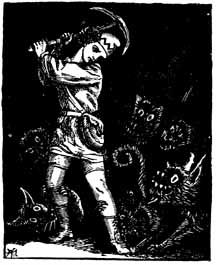
    One night, after dodging about and listening till he was nearly falling asleep with weariness, he began to roll up his ball, for he had resolved to go home to bed. It was not long, however, before he began to feel bewildered. One after another he passed goblin houses, caves, that is, occupied by goblin families, and at length was sure they were many more than he had passed as he came. He had to use great caution to pass unseen - they lay so close together. Could his string have led him wrong? He still followed winding it, and still it led him into more thickly populated quarters, until he became quite uneasy, and indeed apprehensive; for although he was not afraid of the cobs, he was afraid of not finding his way out. But what could he do? It was of no use to sit down and wait for the morning - the morning made no difference here. It was dark, and always dark; and if his string failed him he was helpless. He might even arrive within a yard of the mine and never know it. Seeing he could do nothing better he would at least find where the end of his string was, and, if possible, how it had come to play him such a trick. He knew by the size of the ball that he was getting pretty near the last of it, when he began to feel a tugging and pulling at it. What could it mean? Turning a sharp corner, he thought he heard strange sounds. These grew, as he went on, to a scuffling and growling and squeaking; and the noise increased, until, turning a second sharp corner, he found himself in the midst of it, and the same moment tumbled over a wallowing mass, which he knew must be a knot of the cobs' creatures. Before he could recover his feet, he had caught some great scratches on his face and several severe bites on his legs and arms. But as he scrambled to get up, his hand fell upon his pickaxe, and before the horrid beasts could do him any serious harm, he was laying about with it right and left in the dark. The hideous cries which followed gave him the satisfaction of knowing that he had punished some of them pretty smartly for their rudeness, and by their scampering and their retreating howls, he perceived that he had routed them. He stood for a little, weighing his battle-axe in his hand as if it had been the most precious lump of metal - but indeed no lump of gold itself could have been so precious at the time as that common tool - then untied the end of the string from it, put the ball in his pocket, and still stood thinking. It was clear that the cobs' creatures had found his axe, had between them carried it off, and had so led him he knew not where. But for all his thinking he could not tell what he ought to do, until suddenly he became aware of a glimmer of light in the distance. Without a moment's hesitation he set out for it, as fast as the unknown and rugged way would permit. Yet again turning a corner, led by the dim light, he spied something quite new in his experience of the underground regions - a small irregular shape of something shining. Going up to it, he found it was a piece of mica, or Muscovy glass, called sheep-silver in Scotland, and the light flickered as if from a fire behind it. After trying in vain for some time to discover an entrance to the place where it was burning, he came at length to a small chamber in which an opening, high in the wall, revealed a glow beyond. To this opening he managed to scramble up, and then he saw a strange sight.
    Below sat a little group of goblins around a fire, the smoke of which vanished in the darkness far aloft. The sides of the cave were full of shining minerals like those of the palace hall; and the company was evidently of a superior order, for every one wore stones about head, or arms, or waist, shining dull gorgeous colours in the light of the fire. Nor had Curdie looked long before he recognized the king himself, and found that he had made his way into the inner apartment of the royal family. He had never had such a good chance of hearing something. He crept through the hole as softly as he could, scrambled a good way down the wall towards them without attracting attention, and then sat down and listened. The king, evidently the queen, and probably the crown prince and the Prime Minister were talking together. He was sure of the queen by her shoes, for as she warmed her feet at the fire, he saw them quite plainly.
    'That will be fun!' said the one he took for the crown prince. It was the first whole sentence he heard.
    'I don't see why you should think it such a grand affair!' said his stepmother, tossing her head backward.
    'You must remember, my spouse,' interposed His Majesty, as if making excuse for his son, 'he has got the same blood in him. His mother -'
    'Don't talk to me of his mother! You positively encourage his unnatural fancies. Whatever belongs to that mother ought to be cut out of him.'
    'You forget yourself, my dear!' said the king.
    'I don't,' said the queen, 'nor you either. If you expect me to approve of such coarse tastes, you will find yourself mistaken. I don't wear shoes for nothing.'
    'You must acknowledge, however,' the king said, with a little groan, 'that this at least is no whim of Harelip's, but a matter of State policy. You are well aware that his gratification comes purely from the pleasure of sacrificing himself to the public good.
    Does it not, Harelip?'
    'Yes, father; of course it does. Only it will be nice to make her cry. I'll have the skin taken off between her toes, and tie them up till they grow together. Then her feet will be like other people's, and there will be no occasion for her to wear shoes.'
    'Do you mean to insinuate I've got toes, you unnatural wretch?' cried the queen; and she moved angrily towards Harelip. The councillor, however, who was betwixt them, leaned forward so as to prevent her touching him, but only as if to address the prince.
    'Your Royal Highness,' he said, 'possibly requires to be reminded that you have got three toes yourself - one on one foot, two on the other.'
    'Ha! ha! ha!' shouted the queen triumphantly.
    The councillor, encouraged by this mark of favour, went on.
    'It seems to me, Your Royal Highness, it would greatly endear you to your future people, proving to them that you are not the less one of themselves that you had the misfortune to be born of a sun-mother, if you were to command upon yourself the comparatively slight operation which, in a more extended form, you so wisely meditate with regard to your future princess.'
    'Ha! ha! ha!' laughed the queen louder than before, and the king and the minister joined in the laugh. Harelip growled, and for a few moments the others continued to express their enjoyment of his discomfiture.
    The queen was the only one Curdie could see with any distinctness. She sat sideways to him, and the light of the fire shone full upon her face. He could not consider her handsome. Her nose was certainly broader at the end than its extreme length, and her eyes, instead of being horizontal, were set up like two perpendicular eggs, one on the broad, the other on the small end. Her mouth was no bigger than a small buttonhole until she laughed, when it stretched from ear to ear - only, to be sure, her ears were very nearly in the middle of her cheeks.
    Anxious to hear everything they might say, Curdie ventured to slide down a smooth part of the rock just under him, to a projection below, upon which he thought to rest. But whether he was not careful enough, or the projection gave way, down he came with a rush on the floor of the cavern, bringing with him a great rumbling shower of stones.
    The goblins jumped from their seats in more anger than consternation, for they had never yet seen anything to be afraid of in the palace. But when they saw Curdie with his pick in his hand their rage was mingled with fear, for they took him for the first of an invasion of miners. The king notwithstanding drew himself up to his full height of four feet, spread himself to his full breadth of three and a half, for he was the handsomest and squarest of all the goblins, and strutting up to Curdie, planted himself with outspread feet before him, and said with dignity:
    'Pray what right have you in my palace?'
    'The right of necessity, Your Majesty,' answered Curdie. 'I lost my way and did not know where I was wandering to.'
    'How did you get in?'
    'By a hole in the mountain.'
    'But you are a miner! Look at your pickaxe!'
    Curdie did look at it, answering:
    'I came upon it lying on the ground a little way from here. I tumbled over some wild beasts who were playing with it. Look, Your Majesty.' And Curdie showed him how he was scratched and bitten.
    The king was pleased to find him behave more politely than he had expected from what his people had told him concerning the miners, for he attributed it to the power of his own presence; but he did not therefore feel friendly to the intruder.
    'You will oblige me by walking out of my dominions at once,' he said, well knowing what a mockery lay in the words.
    'With pleasure, if Your Majesty will give me a guide,' said Curdie.
    'I will give you a thousand,' said the king with a scoffing air of magnificent liberality.
    'One will be quite sufficient,' said Curdie.
    But the king uttered a strange shout, half halloo, half roar, and in rushed goblins till the cave was swarming. He said something to the first of them which Curdie could not hear, and it was passed from one to another till in a moment the farthest in the crowd had evidently heard and understood it. They began to gather about him in a way he did not relish, and he retreated towards the wall. They pressed upon him.
    'Stand back,' said Curdie, grasping his pickaxe tighter by his knee.
    They only grinned and pressed closer. Curdie bethought himself and began to rhyme.

'Ten, twenty, thirty -
You're all so very dirty!
Twenty, thirty, forty -
You're all so thick and snorty!

'Thirty, forty, fifty -
You're all so puff-and-snifty!
Forty, fifty, sixty -
Beast and man so mixty!

'Fifty, sixty, seventy -
Mixty, maxty, leaventy!
Sixty, seventy, eighty -
All your cheeks so slaty.

'Seventy, eighty, ninety,
All your hands so flinty!
Eighty, ninety, hundred,
Altogether dundred!'

    The goblins fell back a little when he began, and made horrible grimaces all through the rhyme, as if eating something so disagreeable that it set their teeth on edge and gave them the creeps; but whether it was that the rhyming words were most of them no words at all, for, a new rhyme being considered the more efficacious, Curdie had made it on the spur of the moment, or whether it was that the presence of the king and queen gave them courage, I cannot tell; but the moment the rhyme was over they crowded on him again, and out shot a hundred long arms, with a multitude of thick nailless fingers at the ends of them, to lay hold upon him. Then Curdie heaved up his axe. But being as gentle as courageous and not wishing to kill any of them, he turned the end which was square and blunt like a hammer, and with that came down a great blow on the head of the goblin nearest him. Hard as the heads of all goblins are, he thought he must feel that. And so he did, no doubt; but he only gave a horrible cry, and sprung at Curdie's throat. Curdie, however, drew back in time, and just at that critical moment remembered the vulnerable part of the goblin body. He made a sudden rush at the king and stamped with all his might on His Majesty's feet. The king gave a most unkingly howl and almost fell into the fire. Curdie then rushed into the crowd, stamping right and left. The goblins drew back, howling on every side as he approached, but they were so crowded that few of those he attacked could escape his tread; and the shrieking and roaring that filled the cave would have appalled Curdie but for the good hope it gave him. They were tumbling over each other in heaps in their eagerness to rush from the cave, when a new assailant suddenly faced him - the queen, with flaming eyes and expanded nostrils, her hair standing half up from her head, rushed at him. She trusted in her shoes: they were of granite - hollowed like French sabots. Curdie would have endured much rather than hurt a woman, even if she was a goblin; but here was an affair of life and death: forgetting her shoes, he made a great stamp on one of her feet. But she instantly returned it with very different effect, causing him frightful pain, and almost disabling him. His only chance with her would have been to attack the granite shoes with his pickaxe, but before he could think of that she had caught him up in her arms and was rushing with him across the cave. She dashed him into a hole in the wall, with a force that almost stunned him. But although he could not move, he was not too far gone to hear her great cry, and the rush of multitudes of soft feet, followed by the sounds of something heaved up against the rock; after which came a multitudinous patter of stones falling near him. The last had not ceased when he grew very faint, for his head had been badly cut, and at last insensible.

The goblins fell back a little when he began, and made horrible
grimaces all through the rhyme,


    When he came to himself there was perfect silence about him, and utter darkness, but for the merest glimmer in one tiny spot. He crawled to it, and found that they had heaved a slab against the mouth of the hole, past the edge of which a poor little gleam found its way from the fire. He could not move it a hairbreadth, for they had piled a great heap of stones against it. He crawled back to where he had been lying, in the faint hope of finding his pickaxe, But after a vain search he was at last compelled to acknowledge himself in an evil plight. He sat down and tried to think, but soon fell fast asleep.
   

CHAPTER 19
Goblin Counsels


    He must have slept a long time, for when he awoke he felt wonderfully restored - indeed almost well - and very hungry. There were voices in the outer cave.
    Once more, then, it was night; for the goblins slept during the day and went about their affairs during the night.
    In the universal and constant darkness of their dwelling they had no reason to prefer the one arrangement to the other; but from aversion to the sun-people they chose to be busy when there was least chance of their being met either by the miners below, when they were burrowing, or by the people of the mountain above, when they were feeding their sheep or catching their goats. And indeed it was only when the sun was away that the outside of the mountain was sufficiently like their own dismal regions to be endurable to their mole eyes, so thoroughly had they become unaccustomed to any light beyond that of their own fires and torches.
    Curdie listened, and soon found that they were talking of himself.
    'How long will it take?' asked Harelip.
    'Not many days, I should think,' answered the king. 'They are poor feeble creatures, those sun-people, and want to be always eating. We can go a week at a time without food, and be all the better for it; but I've been told they eat two or three times every day! Can you believe it? They must be quite hollow inside - not at all like us, nine-tenths of whose bulk is solid flesh and bone. Yes - I judge a week of starvation will do for him.' 'If I may be allowed a word,' interposed the queen, - 'and I think I ought to have some voice in the matter -'
    'The wretch is entirely at your disposal, my spouse,' interrupted the king. 'He is your property. You caught him yourself.We should never have done it.'
    The queen laughed. She seemed in far better humour than the night before.
    'I was about to say,' she resumed, 'that it does seem a pity to waste so much fresh meat.'
    'What are you thinking of, my love?' said the king. 'The very notion of starving him implies that we are not going to give him any meat, either salt or fresh.'
    'I'm not such a stupid as that comes to,' returned Her Majesty. 'What I mean is that by the time he is starved there will hardly be a picking upon his bones.'
    The king gave a great laugh.
    'Well, my spouse, you may have him when you like,' he said. 'I don't fancy him for my part. I am pretty sure he is tough eating.'
    'That would be to honour instead of punish his insolence,' returned the queen. 'But why should our poor creatures be deprived of so much nourishment? Our little dogs and cats and pigs and small bears would enjoy him very much.'
    'You are the best of housekeepers, my lovely queen!' said her husband. 'Let it be so by all means. Let us have our people in, and get him out and kill him at once. He deserves it. The mischief he might have brought upon us, now that he had penetrated so far as our most retired citadel, is incalculable. Or rather let us tie him hand and foot, and have the pleasure of seeing him torn to pieces by full torchlight in the great hall.'
    'Better and better!' cried the queen and the prince together, both of them clapping their hands. And the prince made an ugly noise with his hare-lip, just as if he had intended to be one at the feast.
    'But,' added the queen, bethinking herself, 'he is so troublesome. For poor creatures as they are, there is something about those sun-people that is very troublesome. I cannot imagine how it is that with such superior strength and skill and understanding as ours, we permit them to exist at all. Why do we not destroy them entirely, and use their cattle and grazing lands at our pleasure? Of course we don't want to live in their horrid country! It is far too glaring for our quieter and more refined tastes. But we might use it as a sort of outhouse, you know. Even our creatures' eyes might get used to it, and if they did grow blind that would be of no consequence, provided they grew fat as well. But we might even keep their great cows and other creatures, and then we should have a few more luxuries, such as cream and cheese, which at present we only taste occasionally, when our brave men have succeeded in carrying some off from their farms.'
    'It is worth thinking of,' said the king; 'and I don't know why you should be the first to suggest it, except that you have a positive genius for conquest. But still, as you say, there is something very troublesome about them; and it would be better, as I understand you to suggest, that we should starve him for a day or two first, so that he may be a little less frisky when we take him out.'

'Once there was a goblin
Living in a hole;
Busy he was cobblin'
A shoe without a sole.

'By came a birdie:
"Goblin, what do you do?"
"Cobble at a sturdie
Upper leather shoe."

'"What's the good o' that, Sir?"
Said the little bird.
"Why it's very Pat, Sir -
Plain without a word.

'"Where 'tis all a hill, Sir,
Never can be holes:
Why should their shoes have soles, Sir,
When they've got no souls?"'


    'What's that horrible noise?' cried the queen, shuddering from pot-metal head to granite shoes.
    'I declare,' said the king with solemn indignation, 'it's the sun-creature in the hole!'
    'Stop that disgusting noise!' cried the crown prince valiantly, getting up and standing in front of the heap of stones, with his face towards Curdie's prison. 'Do now, or I'll break your head.'
    'Break away,' shouted Curdie, and began singing again:
    'Once there was a goblin, Living in a hole -'
    'I really cannot bear it,' said the queen. 'If I could only get at his horrid toes with my slippers again!' 'I think we had better go to bed,' said the king.
    'It's not time to go to bed,' said the queen.
    'I would if I was you,' said Curdie.
    'Impertinent wretch!' said the queen, with the utmost scorn in her voice.
    'An impossible if,' said His Majesty with dignity.
    'Quite,' returned Curdie, and began singing again:

'Go to bed,
Goblin, do.
Help the queen
Take off her shoe.

'If you do,
It will disclose
A horrid set
Of sprouting toes.'


    'What a lie!' roared the queen in a rage.
    'By the way, that reminds me,' said the king, 'that for as long as we have been married, I have never seen your feet, queen. I think you might take off your shoes when you go to bed! They positively hurt me sometimes.'
    'I will do as I like,' retorted the queen sulkily.
    'You ought to do as your own hubby wishes you,' said the king.
    'I will not,' said the queen.
    'Then I insist upon it,' said the king.
    Apparently His Majesty approached the queen for the purpose of following the advice given by Curdie, for the latter heard a scuffle, and then a great roar from the king.
    'Will you be quiet, then?' said the queen wickedly.
    'Yes, yes, queen. I only meant to coax you.'
    'Hands off!' cried the queen triumphantly. 'I'm going to bed. You may come when you like. But as long as I am queen I will sleep in my shoes. It is my royal privilege. Harelip, go to bed.'
    'I'm going,' said Harelip sleepily.
    'So am I,' said the king.
    'Come along, then,' said the queen; 'and mind you are good, or I'll -'
    'Oh, no, no, no!' screamed the king in the most supplicating of tones.
    Curdie heard only a muttered reply in the distance; and then the cave was quite still.
    They had left the fire burning, and the light came through brighter than before. Curdie thought it was time to try again if anything could be done. But he found he could not get even a finger through the chink between the slab and the rock. He gave a great rush with his shoulder against the slab, but it yielded no more than if it had been part of the rock. All he could do was to sit down and think again.
    By and by he came to the resolution to pretend to be dying, in the hope they might take him out before his strength was too much exhausted to let him have a chance. Then, for the creatures, if he could but find his axe again, he would have no fear of them; and if it were not for the queen's horrid shoes, he would have no fear at all. Meantime, until they should come again at night, there was nothing for him to do but forge new rhymes, now his only weapons. He had no intention of using them at present, of course; but it was well to have a stock, for he might live to want them, and the manufacture of them would help to while away the time.
   

CHAPTER 20
Irene's Clue


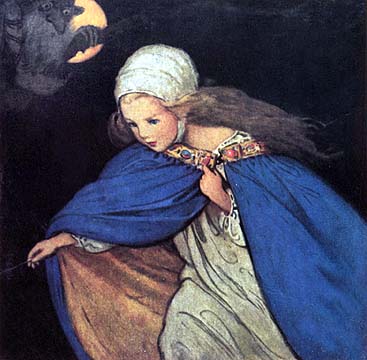
    That same morning early, the princess woke in a terrible fright. There was a hideous noise in her room - creatures snarling and hissing and rocketing about as if they were fighting. The moment she came to herself, she remembered something she had never thought of again - what her grandmother told her to do when she was frightened. She immediately took off her ring and put it under her pillow. As she did so she fancied she felt a finger and thumb take it gently from under her palm. 'It must be my grandmother!' she said to herself, and the thought gave her such courage that she stopped to put on her dainty little slippers before running from the room. While doing this she caught sight of a long cloak of sky-blue, thrown over the back of a chair by the bedside. She had never seen it before but it was evidently waiting for her. She put it on, and then, feeling with the forefinger of her right hand, soon found her grandmother's thread, which she proceeded at once to follow, expecting it would lead her straight up the old stair. When she reached the door she found it went down and ran along the floor, so that she had almost to crawl in order to keep a hold of it. Then, to her surprise, and somewhat to her dismay, she found that instead of leading her towards the stair it turned in quite the opposite direction. It led her through certain narrow passages towards the kitchen, turning aside ere she reached it, and guiding her to a door which communicated with a small back yard. Some of the maids were already up, and this door was standing open. Across the yard the thread still ran along the ground, until it brought her to a door in the wall which opened upon the Mountainside. When she had passed through, the thread rose to about half her height, and she could hold it with ease as she walked. It led her straight up the mountain.
    The cause of her alarm was less frightful than she supposed. The cook's great black cat, pursued by the housekeeper's terrier, had bounced against her bedroom door, which had not been properly fastened, and the two had burst into the room together and commenced a battle royal. How the nurse came to sleep through it was a mystery, but I suspect the old lady had something to do with it.
    It was a clear warm morning. The wind blew deliciously over the Mountainside. Here and there she saw a late primrose but she did not stop to call upon them. The sky was mottled with small clouds.
    The sun was not yet up, but some of their fluffy edges had caught his light, and hung out orange and gold-coloured fringes upon the air. The dew lay in round drops upon the leaves, and hung like tiny diamond ear-rings from the blades of grass about her path.
    'How lovely that bit of gossamer is!' thought the princess, looking at a long undulating line that shone at some distance from her up the hill. It was not the time for gossamers though; and Irene soon discovered that it was her own thread she saw shining on before her in the light of the morning. It was leading her she knew not whither; but she had never in her life been out before sunrise, and everything was so fresh and cool and lively and full of something coming, that she felt too happy to be afraid of anything.
    After leading her up a good distance, the thread turned to the left, and down the path upon which she and Lootie had met Curdie. But she never thought of that, for now in the morning light, with its far outlook over the country, no path could have been more open and airy and cheerful. She could see the road almost to the horizon, along which she had so often watched her king-papa and his troop come shining, with the bugle- blast cleaving the air before them; and it was like a companion to her. Down and down the path went, then up, and then down and then up again, getting rugged and more rugged as it went; and still along the path went the silvery thread, and still along the thread went Irene's little rosy-tipped forefinger. By and by she came to a little stream that jabbered and prattled down the hill, and up the side of the stream went both path and thread. And still the path grew rougher and steeper, and the mountain grew wilder, till Irene began to think she was going a very long way from home; and when she turned to look back she saw that the level country had vanished and the rough bare mountain had closed in about her. But still on went the thread, and on went the princess. Everything around her was getting brighter and brighter as the sun came nearer; till at length his first rays all at once alighted on the top of a rock before her, like some golden creature fresh from the sky. Then she saw that the little stream ran out of a hole in that rock, that the path did not go past the rock, and that the thread was leading her straight up to it. A shudder ran through her from head to foot when she found that the thread was actually taking her into the hole out of which the stream ran. It ran out babbling joyously, but she had to go in.
    She did not hesitate. Right into the hole she went, which was high enough to let her walk without stooping. For a little way there was a brown glimmer, but at the first turn it all but ceased, and before she had gone many paces she was in total darkness. Then she began to be frightened indeed. Every moment she kept feeling the thread backwards and forwards, and as she went farther and farther into the darkness of the great hollow mountain, she kept thinking more and more about her grandmother, and all that she had said to her, and how kind she had been, and how beautiful she was, and all about her lovely room, and the fire of roses, and the great lamp that sent its light through stone walls. And she became more and more sure that the thread could not have gone there of itself, and that her grandmother must have sent it. But it tried her dreadfully when the path went down very steep, and especially When she came to places where she had to go down rough stairs, and even sometimes a ladder. Through one narrow passage after another, over lumps of rock and sand and clay, the thread guided her, until she came to a small hole through which she had to creep. Finding no change on the other side, 'Shall I ever get back?' she thought, over and over again, wondering at herself that she was not ten times more frightened, and often feeling as if she were only walking in the story of a dream. Sometimes she heard the noise of water, a dull gurgling inside the rock. By and by she heard the sounds of blows, which came nearer and nearer; but again they grew duller, and almost died away. In a hundred directions she turned, obedient to the guiding thread.
    At last she spied a dull red shine, and came up to the mica window, and thence away and round about, and right, into a cavern, where glowed the red embers of a fire. Here the thread began to rise. It rose as high as her head and higher still. What should she do if she lost her hold? She was pulling it down: She might break it! She could see it far up, glowing as red as her fire-opal in the light of the embers.
    But presently she came to a huge heap of stones, piled in a slope against the wall of the cavern. On these she climbed, and soon recovered the level of the thread only however to find, the next moment, that it vanished through the heap of stones, and left her standing on it, with her face to the solid rock. For one terrible moment she felt as if her grandmother had forsaken her. The thread which the spiders had spun far over the seas, which her grandmother had sat in the moonlight and spun again for her, which she had tempered in the rose-fire and tied to her opal ring, had left her - had gone where she could no longer follow it - had brought her into a horrible cavern, and there left her! She was forsaken indeed!
    'When shall I wake?' she said to herself in an agony, but the same moment knew that it was no dream. She threw herself upon the heap, and began to cry. It was well she did not know what creatures, one of them with stone shoes on her feet, were lying in the next cave. But neither did she know who was on the other side of the slab.
    At length the thought struck her that at least she could follow the thread backwards, and thus get out of the mountain, and home. She rose at once, and found the thread. But the instant she tried to feel it backwards, it vanished from her touch. Forwards, it led her hand up to the heap of stones - backwards it seemed nowhere. Neither could she see it as before in the light of the fire. She burst into a wailing cry, and again threw herself down on the stones.
   

CHAPTER 21
The Escape


    As the princess lay and sobbed she kept feeling the thread mechanically, following it with her finger many times up to the stones in which it disappeared. By and by she began, still mechanically, to poke her finger in after it between the stones as far as she could. All at once it came into her head that she might remove some of the stones and see where the thread went next. Almost laughing at herself for never having thought of this before, she jumped to her feet. Her fear vanished; once more she was certain her grandmother's thread could not have brought her there just to leave her there; and she began to throw away the stones from the top as fast as she could, sometimes two or three at a handful, sometimes taking both hands to lift one. After clearing them away a little, she found that the thread turned and went straight downwards. Hence, as the heap sloped a good deal, growing of course wider towards its base, she had to throw away a multitude of stones to follow the thread. But this was not all, for she soon found that the thread, after going straight down for a little way, turned first sideways in one direction, then sideways in another, and then shot, at various angles, hither and thither inside the heap, so that she began to be afraid that to clear the thread she must remove the whole huge gathering. She was dismayed at the very idea, but, losing no time, set to work with a will; and with aching back, and bleeding fingers and hands, she worked on, sustained by the pleasure of seeing the heap slowly diminish and begin to show itself on the opposite side of the fire. Another thing which helped to keep up her courage was that, as often as she uncovered a turn of the thread, instead of lying loose upon the stone, it tightened up; this made her sure that her grandmother was at the end of it somewhere.
    She had got about half-way down when she started, and nearly fell with fright. Close to her ears as it seemed, a voice broke out singing:
    'Jabber, bother, smash! You'll have it all in a crash. Jabber, smash, bother! You'll have the worst of the pother. Smash, bother, jabber! -'
    Here Curdie stopped, either because he could not find a rhyme to 'jabber', or because he remembered what he had forgotten when he woke up at the sound of Irene's labours, that his plan was to make the goblins think he was getting weak. But he had uttered enough to let Irene know who he was.
    'It's Curdie!' she cried joyfully.
    'Hush! hush!' came Curdie's voice again from somewhere. 'Speak softly.'
    'Why, you were singing loud!' said Irene.
    'Yes. But they know I am here, and they don't know you are. Who are you?'
    'I'm Irene,' answered the princess. 'I know who you are quite well. You're Curdie.'
    'Why, how ever did you come here, Irene?'
    'My great-great-grandmother sent me; and I think I've found out why. You can't get out, I suppose?'
    'No, I can't. What are you doing?'
    'Clearing away a huge heap of stones.'
    'There's a princess!' exclaimed Curdie, in a tone of delight, but still speaking in little more than a whisper. 'I can't think how you got here, though.'
    'my grandmother sent me after her thread.'
    'I don't know what you mean,' said Curdie; 'but so you're there, it doesn't much matter.'
    'Oh, yes, it does!' returned Irene. 'I should never have been here but for her.'
    'You can tell me all about it when we get out, then. There's no time to lose now,'said Curdie.
    And Irene went to work, as fresh as when she began.
    'There's such a lot of stones!' she said. 'It will take me a long time to get them all away.'
    'How far on have you got?' asked Curdie.
    'I've got about the half away, but the other half is ever so much bigger.'
    'I don't think you will have to move the lower half. Do you see a slab laid up against the wall?'
    Irene looked, and felt about with her hands, and soon perceived the outlines of the slab.
    'Yes,' she answered, 'I do.'
    'Then, I think,' rejoined Curdie, 'when you have cleared the slab about half-way down, or a bit more, I shall be able to push it over.'
    'I must follow my thread,' returned Irene, 'whatever I do.'
    'What do you mean?'exclaimed Curdie. 'You will see when you get out,' answered the princess, and went on harder than ever.
    But she was soon satisfied that what Curdie wanted done and what the thread wanted done were one and the same thing. For she not only saw that by following the turns of the thread she had been clearing the face of the slab, but that, a little more than half-way down, the thread went through the chink between the slab and the wall into the place where Curdie was confined, so that she could not follow it any farther until the slab was out of her way. As soon as she found this, she said in a right joyous whisper:
    'Now, Curdie, I think if you were to give a great push, the slab would tumble over.'
    'Stand quite clear of it, then,' said Curdie, 'and let me know when you are ready.'
    Irene got off the heap, and stood on one side of it. 'Now, Curdie!' she cried.
    Curdie gave a great rush with his shoulder against it. Out tumbled the slab on the heap, and out crept Curdie over the top of it.
    'You've saved my life, Irene!' he whispered.
    'Oh, Curdie! I'm so glad! Let's get out of this horrid place as fast as we can.'
    'That's easier said than done,' returned he.
    'Oh, no, it's quite easy,' said Irene. 'We have only to follow my thread. I am sure that it's going to take us out now.'
    She had already begun to follow it over the fallen slab into the hole, while Curdie was searching the floor of the cavern for his pickaxe.
    'Here it is!' he cried. 'No, it is not,' he added, in a disappointed tone. 'What can it be, then? I declare it's a torch. That is jolly! It's better almost than my pickaxe. Much better if it weren't for those stone shoes!' he went on, as he lighted the torch by blowing the last embers of the expiring fire.
    When he looked up, with the lighted torch casting a glare into the great darkness of the huge cavern, he caught sight of Irene disappearing in the hole out of which he had himself just come.
    'Where are you going there?' he cried. 'That's not the way out. That's where I couldn't get out.'
    'I know that,' whispered Irene. 'But this is the way my thread goes, and I must follow it.'
    'What nonsense the child talks!' said Curdie to himself. 'I must follow her, though, and see that she comes to no harm. She will soon find she can't get out that way, and then she will come with me.'
    So he crept over the slab once more into the hole with his torch in his hand. But when he looked about in it, he could see her nowhere. And now he discovered that although the hole was narrow, it was much longer than he had supposed; for in one direction the roof came down very low, and the hole went off in a narrow passage, of which he could not see the end. The princess must have crept in there. He got on his knees and one hand, holding the torch with the other, and crept after her. The hole twisted about, in some parts so low that he could hardly get through, in others so high that he could not see the roof, but everywhere it was narrow - far too narrow for a goblin to get through, and so I presume they never thought that Curdie might. He was beginning to feel very uncomfortable lest something should have befallen the princess, when he heard her voice almost close to his ear, whispering:
    'Aren't you coming, Curdie?'
    And when he turned the next corner there she stood waiting for him.
    'I knew you couldn't go wrong in that narrow hole, but now you must keep by me, for here is a great wide place,' she said.
    'I can't understand it,' said Curdie, half to himself, half to Irene.
    'Never mind,' she returned. 'Wait till we get out.'
    Curdie, utterly astonished that she had already got so far, and by a path he had known nothing of, thought it better to let her do as she pleased.
    "At all events," he said again to himself, "I know nothing about the way, miner as I am; and she seems to think she does know something about it, though how she should, passes my comprehension. So she's just as likely to find her way as I am, and as she insists on taking the lead, I must follow. We can't be much worse off than we are, anyhow."
    Reasoning thus, he followed her a few steps, and came out in another great cavern, across which Irene walked in a straight line, as confidently as if she knew every step of the way. Curdie went on after her, flashing his torch about, and trying to see something of what lay around them. Suddenly he started back a pace as the light fell upon something close by which Irene was passing. It was a platform of rock raised a few feet from the floor and covered with sheepskins, upon which lay two horrible figures asleep, at once recognized by Curdie as the king and queen of the goblins. He lowered his torch instantly lest the light should awake them. As he did so it flashed upon his pickaxe, lying by the side of the queen, whose hand lay close by the handle of it.

Curdie went on after her, flashing his torch about,


    'Stop one moment,' he whispered. 'Hold my torch, and don't let the light on their faces.'
    Irene shuddered when she saw the frightful creatures, whom she had passed without observing them, but she did as he requested, and turning her back, held the torch low in front of her. Curdie drew his pickaxe carefully away, and as he did so spied one of her feet, projecting from under the skins. The great clumsy granite shoe, exposed thus to his hand, was a temptation not to be resisted. He laid hold of it, and, with cautious efforts, drew it off. The moment he succeeded, he saw to his astonishment that what he had sung in ignorance, to annoy the queen, was actually true: she had six horrible toes. Overjoyed at his success, and seeing by the huge bump in the sheepskins where the other foot was, he proceeded to lift them gently, for, if he could only succeed in carrying away the other shoe as well, he would be no more afraid of the goblins than of so many flies. But as he pulled at the second shoe the queen gave a growl and sat up in bed. The same instant the king awoke also and sat up beside her.
    'Run, Irene!' cried Curdie, for though he was not now in the least afraid for himself, he was for the princess.
    Irene looked once round, saw the fearful creatures awake, and like the wise princess she was, dashed the torch on the ground and extinguished it, crying out:
    'Here, Curdie, take my hand.'
    He darted to her side, forgetting neither the queen's shoe nor his pickaxe, and caught hold of her hand, as she sped fearlessly where her thread guided her. They heard the queen give a great bellow; but they had a good start, for it would be some time before they could get torches lighted to pursue them. just as they thought they saw a gleam behind them, the thread brought them to a very narrow opening, through which Irene crept easily, and Curdie with difficulty.
    'Now,'said Curdie; 'I think we shall be safe.'
    'Of course we shall,' returned Irene. 'Why do you think so?'asked Curdie.
    'Because my grandmother is taking care of us.'
    'That's all nonsense,' said Curdie. 'I don't know what you mean.'
    'Then if you don't know what I mean, what right have you to call it nonsense?' asked the princess, a little offended.
    'I beg your pardon, Irene,' said Curdie; 'I did not mean to vex you.'
    'Of course not,' returned the princess. 'But why do you think we shall be safe?' 'Because the king and queen are far too stout to get through that hole.'
    'There might be ways round,' said the princess.
    'To be sure there might: we are not out of it yet,' acknowledged Curdie.
    'But what do you mean by the king and queen?' asked the princess. 'I should never call such creatures as those a king and a queen.'
    'Their own people do, though,' answered Curdie.
    The princess asked more questions, and Curdie, as they walked leisurely along, gave her a full account, not only of the character and habits of the goblins, so far as he knew them, but of his own adventures with them, beginning from the very night after that in which he had met her and Lootie upon the mountain. When he had finished, he begged Irene to tell him how it was that she had come to his rescue. So Irene too had to tell a long story, which she did in rather a roundabout manner, interrupted by many questions concerning things she had not explained. But her tale, as he did not believe more than half of it, left everything as unaccountable to him as before, and he was nearly as much perplexed as to what he must think of the princess. He could not believe that she was deliberately telling stories, and the only conclusion he could come to was that Lootie had been playing the child tricks, inventing no end of lies to frighten her for her own purposes.
    'But how ever did Lootie come to let you go into the mountains alone?'he asked.
    'Lootie knows nothing about it. I left her fast asleep - at least I think so. I hope my grandmother won't let her get into trouble, for it wasn't her fault at all, as my grandmother very well knows.'
    'But how did you find your way to me?' persisted Curdie.
    'I told you already,' answered Irene; 'by keeping my finger upon my grandmother's thread, as I am doing now.'
    'You don't mean you've got the thread there?'
    'Of course I do. I have told you so ten times already. I have hardly - except when I was removing the stones - taken my finger off it. There!' she added, guiding Curdie's hand to the thread, 'you feel it yourself - don't you?'
    'I feel nothing at all,' replied Curdie. 'Then what can be the matter with your finger? I feel it perfectly. To be sure it is very thin, and in the sunlight looks just like the thread of a spider, though there are many of them twisted together to make it - but for all that I can't think why you shouldn't feel it as well as I do.'
    Curdie was too polite to say he did not believe there was any thread there at all. What he did say was:
    'Well, I can make nothing of it.'
    'I can, though, and you must be glad of that, for it will do for both of us.'
    'We're not out yet,' said Curdie.
    'We soon shall be,' returned Irene confidently. And now the thread went downwards, and led Irene's hand to a hole in the floor of the cavern, whence came a sound of running water which they had been hearing for some time.
    'It goes into the ground now, Curdie,' she said, stopping.
    He had been listening to another sound, which his practised ear had caught long ago, and which also had been growing louder. It was the noise the goblin-miners made at their work, and they seemed to be at no great distance now. Irene heard it the moment she stopped.
    'What is that noise?' she asked. 'Do you know, Curdie?'
    'Yes. It is the goblins digging and burrowing,' he answered.
    'And you don't know what they do it for?'
    'No; I haven't the least idea. Would you like to see them?' he asked, wishing to have another try after their secret.
    'If my thread took me there, I shouldn't much mind; but I don't want to see them, and I can't leave my thread. It leads me down into the hole, and we had better go at once.'
    'Very well. Shall I go in first?' said Curdie.
    'No; better not. You can't feel the thread,' she answered, stepping down through a narrow break in the floor of the cavern. 'Oh!' she cried, 'I am in the water. It is running strong - but it is not deep, and there is just room to walk. Make haste, Curdie.'
    He tried, but the hole was too small for him to get in.
    'Go on a little bit he said, shouldering his pickaxe. In a few moments he had cleared a larger opening and followed her. They went on, down and down with the running water, Curdie getting more and more afraid it was leading them to some terrible gulf in the heart of the mountain. In one or two places he had to break away the rock to make room before even Irene could get through - at least without hurting herself. But at length they spied a glimmer of light, and in a minute more they were almost blinded by the full sunlight, into which they emerged. It was some little time before the princess could see well enough to discover that they stood in her own garden, close by the seat on which she and her king-papa had sat that afternoon. They had come out by the channel of the little stream. She danced and clapped her hands with delight.
    'Now, Curdie!' she cried, 'won't you believe what I told you about my grandmother and her thread?'
    For she had felt all the time that Curdie was not believing what she told him.
    'There! - don't you see it shining on before us?' she added.
    'I don't see anything,' persisted Curdie.
    'Then you must believe without seeing,' said the princess; 'for you can't deny it has brought us out of the mountain.'
    'I can't deny we are out of the mountain, and I should be very ungrateful indeed to deny that you had brought me out of it.'
    'I couldn't have done it but for the thread,' persisted Irene.
    'That's the part I don't understand.'
    'well, come along, and Lootie will get you something to eat. I am sure you must want it very much.'
    'Indeed I do. But my father and mother will be so anxious about me, I must make haste - first up the mountain to tell my mother, and then down into the mine again to let my father know.'
    'Very well, Curdie; but you can't get out without coming this way, and I will take you through the house, for that is nearest.'
    They met no one by the way, for, indeed, as before, the people were here and there and everywhere searching for the princess. When they got in Irene found that the thread, as she had half expected, went up the old staircase, and a new thought struck her. She turned to Curdie and said:
    'My grandmother wants me. Do come up with me and see her. Then you will know that I have been telling you the truth. Do come - to please me, Curdie. I can't bear you should think what I say is not true.'
    'I never doubted you believed what you said,' returned Curdie. 'I only thought you had some fancy in your head that was not correct.' 'But do come, dear Curdie.'
    The little miner could not withstand this appeal, and though he felt shy in what seemed to him a huge grand house, he yielded, and followed her up the stair.
   

CHAPTER 22
The Old Lady and Curdie


    Up the stair then they went, and the next and the next, and through the long rows of empty rooms, and up the little tower stair, Irene growing happier and happier as she ascended. There was no answer when she knocked at length at the door of the workroom, nor could she hear any sound of the spinning-wheel, and once more her heart sank within her, but only for one moment, as she turned and knocked at the other door.
    'Come in,' answered the sweet voice of her grandmother, and Irene opened the door and entered, followed by Curdie.
    'You darling!' cried the lady, who was seated by a fire of red roses mingled with white. 'I've been waiting for you, and indeed getting a little anxious about you, and beginning to think whether I had not better go and fetch you myself.'
    As she spoke she took the little princess in her arms and placed her upon her lap. She was dressed in white now, and looking if possible more lovely than ever.
    'I've brought Curdie, grandmother. He wouldn't believe what I told him and so I've brought him.'
    'Yes - I see him. He is a good boy, Curdie, and a brave boy. Aren't you glad you've got him out?'
    'Yes, grandmother. But it wasn't very good of him not to believe me when I was telling him the truth.'
    'People must believe what they can, and those who believe more must not be hard upon those who believe less. I doubt if you would have believed it all yourself if you hadn't seen some of it.'
    'Ah! yes, grandmother, I dare say. I'm sure you are right. But he'll believe now.'
    'I don't know that,' replied her grandmother.
    'Won't you, Curdie?' said Irene, looking round at him as she asked the question. He was standing in the middle of the floor, staring, and looking strangely bewildered. This she thought came of his astonishment at the beauty of the lady. 'Make a bow to my grandmother, Curdie,' she said.
    'I don't see any grandmother,' answered Curdie rather gruffly.
    'Don't see my grandmother, when I'm sitting in her lap?' exclaimed the princess.
    'No, I don't,' reiterated Curdie, in an offended tone.
    'Don't you see the lovely fire of roses - white ones amongst them this time?' asked Irene, almost as bewildered as he.
    'No, I don't,' answered Curdie, almost sulkily.
    'Nor the blue bed? Nor the rose-coloured counterpane? - Nor the beautiful light, like the moon, hanging from the roof?'
    'You're making game of me, Your Royal Highness; and after what we have come through together this day, I don't think it is kind of you,' said Curdie, feeling very much hurt.
    'Then what do you see?' asked Irene, who perceived at once that for her not to believe him was at least as bad as for him not to believe her.
    'I see a big, bare, garret-room - like the one in mother's cottage, only big enough to take the cottage itself in, and leave a good margin all round,' answered Curdie.
    'And what more do you see?'
    'I see a tub, and a heap of musty straw, and a withered apple, and a ray of sunlight coming through a hole in the middle of the roof and shining on your head, and making all the place look a curious dusky brown. I think you had better drop it, princess, and go down to the nursery, like a good girl.'
    'But don't you hear my grandmother talking to me?' asked Irene, almost crying.
    'No. I hear the cooing of a lot of pigeons. If you won't come down, I will go without you. I think that will be better anyhow, for I'm sure nobody who met us would believe a word we said to them. They would think we made it all up. I don't expect anybody but my own father and mother to believe me. They know I wouldn't tell a story.'
    'And yet you won't believe me, Curdie?' expostulated the princess, now fairly crying with vexation and sorrow at the gulf between her and Curdie.
    'No. I can't, and I can't help it,' said Curdie, turning to leave the room.
    'What SHALL I do, grandmother?' sobbed the princess, turning her face round upon the lady's bosom, and shaking with suppressed sobs.
    'You must give him time,' said her grandmother; 'and you must be content not to be believed for a while. It is very hard to bear; but I have had to bear it, and shall have to bear it many a time yet. I will take care of what Curdie thinks of you in the end. You must let him go now.'
    'You're not coming, are you?' asked Curdie.
    'No, Curdie; my grandmother says I must let you go. Turn to the right when you get to the bottom of all the stairs, and that will take you to the hall where the great door is.'
    'Oh! I don't doubt I can find my way - without you, princess, or your old grannie's thread either,' said Curdie quite rudely.
    'Oh, Curdie! Curdie!'
    'I wish I had gone home at once. I'm very much obliged to you, Irene, for getting me out of that hole, but I wish you hadn't made a fool of me afterwards.'
    He said this as he opened the door, which he left open, and, without another word, went down the stair. Irene listened with dismay to his departing footsteps. Then turning again to the lady:
    'What does it all mean, grandmother?' she sobbed, and burst into fresh tears.
    'It means, my love, that I did not mean to show myself. Curdie is not yet able to believe some things. Seeing is not believing - it is only seeing. You remember I told you that if Lootie were to see me, she would rub her eyes, forget the half she saw, and call the other half nonsense.'
    'Yes; but I should have thought Curdie -'
    'You are right. Curdie is much farther on than Lootie, and you will see what will come of it. But in the meantime you must be content, I say, to be misunderstood for a while. We are all very anxious to be understood, and it is very hard not to be. But there is one thing much more necessary.'
    'What is that, grandmother?'
    'To understand other people.'
    'Yes, grandmother. I must be fair - for if I'm not fair to other people, I'm not worth being understood myself. I see. So as Curdie can't help it, I will not be vexed with him, but just wait.'
    'There's my own dear child,' said her grandmother, and pressed her close to her bosom.
    'Why weren't you in your workroom when we came up, grandmother?' asked Irene, after a few moments' silence.
    'If I had been there, Curdie would have seen me well enough. But why should I be there rather than in this beautiful room?'
    'I thought you would be spinning.'
    'I've nobody to spin for just at present. I never spin without knowing for whom I am spinning.'
    'That reminds me - there is one thing that puzzles me,' said the princess: 'how are you to get the thread out of the mountain again? Surely you won't have to make another for me? That would be such a trouble!'
    The lady set her down and rose and went to the fire. Putting in her hand, she drew it out again and held up the shining ball between her finger and thumb.
    'I've got it now, you see,' she said, coming back to the princess, 'all ready for you when you want it.'
    Going to her cabinet, she laid it in the same drawer as before.
    'And here is your ring,' she added, taking it from the little finger of her left hand and putting it on the forefinger of Irene's right hand.
    'Oh, thank you, grandmother! I feel so safe now!'
    'You are very tired, my child,' the lady went on. 'Your hands are hurt with the stones, and I have counted nine bruises on you. just look what you are like.'
    And she held up to her a little mirror which she had brought from the cabinet. The princess burst into a merry laugh at the sight. She was so draggled with the stream and dirty with creeping through narrow places, that if she had seen the reflection without knowing it was a reflection, she would have taken herself for some gipsy child whose face was washed and hair combed about once in a month. The lady laughed too, and lifting her again upon her knee, took off her cloak and night-gown. Then she carried her to the side of the room. Irene wondered what she was going to do with her, but asked no questions - only starting a little when she found that she was going to lay her in the large silver bath; for as she looked into it, again she saw no bottom, but the stars shining miles away, as it seemed, in a great blue gulf. Her hands closed involuntarily on the beautiful arms that held her, and that was all.
    The lady pressed her once more to her bosom, saying:
    'Do not be afraid, my child.'
    'No, grandmother,' answered the princess, with a little gasp; and the next instant she sank in the clear cool water.
    When she opened her eyes, she saw nothing but a strange lovely blue over and beneath and all about her. The lady, and the beautiful room, had vanished from her sight, and she seemed utterly alone. But instead of being afraid, she felt more than happy - perfectly blissful. And from somewhere came the voice of the lady, singing a strange sweet song, of which she could distinguish every word; but of the sense she had only a feeling - no understanding. Nor could she remember a single line after it was gone. It vanished, like the poetry in a dream, as fast as it came. In after years, however, she would sometimes fancy that snatches of melody suddenly rising in her brain must be little phrases and fragments of the air of that song; and the very fancy would make her happier, and abler to do her duty.
    How long she lay in the water she did not know. It seemed a long time - not from weariness but from pleasure. But at last she felt the beautiful hands lay hold of her, and through the gurgling water she was lifted out into the lovely room. The lady carried her to the fire, and sat down with her in her lap, and dried her tenderly with the softest towel. It was so different from Lootie's drying. When the lady had done, she stooped to the fire, and drew from it her night-gown, as white as snow.
    'How delicious!' exclaimed the princess. 'It smells of all the roses in the world, I think.'
    When she stood up on the floor she felt as if she had been made over again. Every bruise and all weariness were gone, and her hands were soft and whole as ever.
    'Now I am going to put you to bed for a good sleep,' said her grandmother.
    'But what will Lootie be thinking? And what am I to say to her when she asks me where I have been?'
    'Don't trouble yourself about it. You will find it all come right,' said her grandmother, and laid her into the blue bed, under the rosy counterpane.
    'There is just one thing more,' said Irene. 'I am a little anxious about Curdie. As I brought him into the house, I ought to have seen him safe on his way home.'
    'I took care of all that,' answered the lady. 'I told you to let him go, and therefore I was bound to look after him. Nobody saw him, and he is now eating a good dinner in his mother's cottage far up in the mountain.'
    'Then I will go to sleep,' said Irene, and in a few minutes she was fast asleep.
   

CHAPTER 23
Curdie and His Mother


    Curdie went up the mountain neither whistling nor singing, for he was vexed with Irene for taking him in, as he called it; and he was vexed with himself for having spoken to her so angrily. His mother gave a cry of joy when she saw him, and at once set about getting him something to eat, asking him questions all the time, which he did not answer so cheerfully as usual. When his meal was ready, she left him to eat it, and hurried to the mine to let his father know he was safe. When she came back, she found him fast asleep upon her bed; nor did he wake until his father came home in the evening.
    'Now, Curdie,' his mother said, as they sat at supper, 'tell us the whole story from beginning to end, just as it all happened.'
    Curdie obeyed, and told everything to the point where they came out upon the lawn in the garden of the king's house.
    'And what happened after that?' asked his mother. 'You haven't told us all. You ought to be very happy at having got away from those demons, and instead of that I never saw you so gloomy. There must be something more. Besides, you do not speak of that lovely child as I should like to hear you. She saved your life at the risk of her own, and yet somehow you don't seem to think much of it.'
    'She talked such nonsense' answered Curdie, 'and told me a pack of things that weren't a bit true; and I can't get over it.'
    'What were they?' asked his father. 'Your mother may be able to throw some light upon them.'
    Then Curdie made a clean breast of it, and told them everything.
    They all sat silent for some time, pondering the strange tale. At last Curdie's mother spoke.
    'You confess, my boy,' she said, 'there is something about the whole affair you do not understand?'
    'Yes, of course, mother,' he answered. 'I cannot understand how a child knowing nothing about the mountain, or even that I was shut up in it, should come all that way alone, straight to where I was; and then, after getting me out of the hole, lead me out of the mountain too, where I should not have known a step of the way if it had been as light as in the open air.' 'Then you have no right to say what she told you was not true. She did take you out, and she must have had something to guide her: why not a thread as well as a rope, or anything else? There is something you cannot explain, and her explanation may be the right one.'
    'It's no explanation at all, mother; and I can't believe it.'
    'That may be only because you do not understand it. If you did, you would probably find it was an explanation, and believe it thoroughly. I don't blame you for not being able to believe it, but I do blame you for fancying such a child would try to deceive you. Why should she? Depend upon it, she told you all she knew. Until you had found a better way of accounting for it all, you might at least have been more sparing of your judgement.'
    'That is what something inside me has been saying all the time,' said Curdie, hanging down his head. 'But what do you make of the grandmother? That is what I can't get over. To take me up to an old garret, and try to persuade me against the sight of my own eyes that it was a beautiful room, with blue walls and silver stars, and no end of things in it, when there was nothing there but an old tub and a withered apple and a heap of straw and a sunbeam! It was too bad! She might have had some old woman there at least to pass for her precious grandmother!'
    'Didn't she speak as if she saw those other things herself, Curdie?'
    'Yes. That's what bothers me. You would have thought she really meant and believed that she saw every one of the things she talked about. And not one of them there! It was too bad, I say.'
    'Perhaps some people can see things other people can't see, Curdie,' said his mother very gravely. 'I think I will tell you something I saw myself once - only Perhaps You won't believe me either!'
    'Oh, mother, mother!' cried Curdie, bursting into tears; 'I don't deserve that, surely!'
    'But what I am going to tell you is very strange,' persisted his mother; 'and if having heard it you were to say I must have been dreaming, I don't know that I should have any right to be vexed with you, though I know at least that I was not asleep.'
    'Do tell me, mother. Perhaps it will help me to think better of the princess.'
    'That's why I am tempted to tell you,' replied his mother. 'But first, I may as well mention that, according to old whispers, there is something more than common about the king's family; and the queen was of the same blood, for they were cousins of some degree. There were strange stories told concerning them - all good stories - but strange, very strange. What they were I cannot tell, for I only remember the faces of my grandmother and my mother as they talked together about them. There was wonder and awe - not fear - in their eyes, and they whispered, and never spoke aloud. But what I saw myself was this: Your father was going to work in the mine one night, and I had been down with his supper. It was soon after we were married, and not very long before you were born. He came with me to the mouth of the mine, and left me to go home alone, for I knew the way almost as well as the floor of our own cottage. It was pretty dark, and in some parts of the road where the rocks overhung nearly quite dark. But I got along perfectly well, never thinking of being afraid, until I reached a spot you know well enough, Curdie, where the path has to make a sharp turn out of the way of a great rock on the left-hand side. When I got there, I was suddenly surrounded by about half a dozen of the cobs, the first I had ever seen, although I had heard tell of them often enough. One of them blocked up the path, and they all began tormenting and teasing me in a way it makes me shudder to think of even now.'
    'If I had only been with you!' cried father and son in a breath.
    The mother gave a funny little smile, and went on.
    'They had some of their horrible creatures with them too, and I must confess I was dreadfully frightened. They had torn my clothes very much, and I was afraid they were going to tear myself to pieces, when suddenly a great white soft light shone upon me. I looked up. A broad ray, like a shining road, came down from a large globe of silvery light, not very high up, indeed not quite so high as the horizon - so it could not have been a new star or another moon or anything of that sort. The cobs dropped persecuting me, and looked dazed, and I thought they were going to run away, but presently they began again. The same moment, however, down the path from the globe of light came a bird, shining like silver in the sun. It gave a few rapid flaps first, and then, with its wings straight out, shot,sliding down the slope of the light. It looked to me just like a white pigeon. But whatever it was, when the cobs caught sight of it coming straight down upon them, they took to their heels and scampered away across the mountain, leaving me safe, only much frightened. As soon as it had sent them off, the bird went gliding again up the light, and the moment it reached the globe the light disappeared, just as if a shutter had been closed over a window, and I saw it no More. But I had no more trouble with the cobs that night or ever after.'
    'How strange!' exclaimed Curdie.
    'Yes, it was strange; but I can't help believing it, whether you do or not,' said his mother.
    'It's exactly as your mother told it to me the very next morning,' said his father.
    'You don't think I'm doubting my own mother?' cried Curdie. 'There are other people in the world quite as well worth believing as your own mother,' said his mother. 'I don't know that she's so much the fitter to be believed that she happens to be your mother, Mr. Curdie. There are mothers far more likely to tell lies than the little girl I saw talking to the primroses a few weeks ago. If she were to lie I should begin to doubt my own word.'
    'But princesses have told lies as well as other people,' said Curdie.
    'Yes, but not princesses like that child. She's a good girl, I am certain, and that's more than being a princess. Depend upon it you will have to be sorry for behaving so to her, Curdie. You ought at least to have held your tongue.'
    'I am sorry now,' answered Curdie.
    'You ought to go and tell her so, then.'
    'I don't see how I could manage that. They wouldn't let a miner boy like me have a word with her alone; and I couldn't tell her before that nurse of hers. She'd be asking ever so many questions, and I don't know how many the little princess would like me to answer. She told me that Lootie didn't know anything about her coming to get me out of the mountain. I am certain she would have prevented her somehow if she had known it. But I may have a chance before long, and meantime I must try to do something for her. I think, father, I have got on the track at last.'
    'Have you, indeed, my boy?' said Peter. 'I am sure you deserve some success; you have worked very hard for it. What have you found out?'
    'It's difficult, you know, father, inside the mountain, especially in the dark, and not knowing what turns you have taken, to tell the lie of things outside.'
    'Impossible, my boy, without a chart, or at least a compass,' returned his father.
    'Well, I think I have nearly discovered in what direction the cobs are mining. If I am right, I know something else that I can put to it, and then one and one will make three.'
    'They very often do, Curdie, as we miners ought to be very well aware. Now tell us, my boy, what the two things are, and see whether we can guess at the same third as you.'
    'I don't see what that has to do with the princess,' interposed his mother.
    'I will soon let you see that, mother. Perhaps you may think me foolish, but until I am sure there, is nothing in my present fancy, I am more determined than ever to go on with my observations. just as we came to the channel by which we got out, I heard the miners at work somewhere near - I think down below us. Now since I began to watch them, they have mined a good half-mile, in a straight line; and so far as I am aware, they are working in no other part of the mountain. But I never could tell in what direction they were going. When we came out in the king's garden, however, I thought at once whether it was possible they were working towards the king's house; and what I want to do tonight is to make sure whether they are or not. I will take a light with me -'
    'Oh, Curdie,' cried his mother, 'then they will see you.'
    'I'm no more afraid of them now than I was before,' rejoined Curdie, 'now that I've got this precious shoe. They can't make another such in a hurry, and one bare foot will do for my purpose. Woman as she may be, I won't spare her next time. But I shall be careful with my light, for I don't want them to see me. I won't stick it in my hat.'
    'Go on, then, and tell us what you mean to do.'
    'I mean to take a bit of paper with me and a pencil, and go in at the mouth of the stream by which we came out. I shall mark on the paper as near as I can the angle of every turning I take until I find the cobs at work, and so get a good idea in what direction they are going. If it should prove to be nearly parallel with the stream, I shall know it is towards the king's house they are working.'
    'And what if you should? How much wiser will you be then?'
    'Wait a minute, mother dear. I told you that when I came upon the royal family in the cave, they were talking of their prince - Harelip, they called him - marrying a sun-woman - that means one of us - one with toes to her feet. Now in the speech one of them made that night at their great gathering, of which I heard only a part, he said that peace would be secured for a generation at least by the pledge the prince would hold for the good behaviour of her relatives: that's what he said, and he must have meant the sun-woman the prince was to marry. I am quite sure the king is much too proud to wish his son to marry any but a princess, and much too knowing to fancy that his having a peasant woman for a wife would be of any great advantage to them.'
    'I see what you are driving at now,' said his mother.
    'But,' said his father, 'our king would dig the mountain to the plain before he would have his princess the wife of a cob, if he were ten times a prince.'
    'Yes; but they think so much of themselves!' said his mother. 'Small creatures always do. The bantam is the proudest cock in my little yard.'
    'And I fancy,' said Curdie, 'if they once got her, they would tell the king they would kill her except he consented to the marriage.'
    'They might say so,' said his father, 'but they wouldn't kill her; they would keep her alive for the sake of the hold it gave them over our king. Whatever he did to them, they would threaten to do the same to the princess.'
    'And they are bad enough to torment her just for their own amusement - I know that,' said his mother.
    'Anyhow, I will keep a watch on them, and see what they are up to,' said Curdie. 'It's too horrible to think of. I daren't let myself do it. But they shan't have her - at least if I can help it. So, mother dear - my clue is all right - will you get me a bit of paper and a pencil and a lump of pease pudding, and I will set out at once. I saw a place where I can climb over the wall of the garden quite easily.'
    'You must mind and keep out of the way of the men on the watch,' said his mother.
    'That I will. I don't want them to know anything about it. They would spoil it all. The cobs would only try some other plan - they are such obstinate creatures! I shall take good care, mother. They won't kill and eat me either, if they should come upon me. So you needn't mind them.'
    His mother got him what he had asked for, and Curdie set out. Close beside the door by which the princess left the garden for the mountain stood a great rock, and by climbing it Curdie got over the wall. He tied his clue to a stone just inside the channel of the stream, and took his pickaxe with him. He had not gone far before he encountered a horrid creature coming towards the mouth. The spot was too narrow for two of almost any size or shape, and besides Curdie had no wish to let the creature pass. Not being able to use his pickaxe, however, he had a severe struggle with him, and it was only after receiving many bites, some of them bad, that he succeeded in killing him with his pocket-knife. Having dragged him out, he made haste to get in again before another should stop up the way.
    I need not follow him farther in this night's adventures. He returned to his breakfast, satisfied that the goblins were mining in the direction of the palace - on so low a level that their intention must, he thought, be to burrow under the walls of the king's house, and rise up inside it - in order, he fully believed, to lay hands on the little princess, and carry her off for a wife to their horrid Harelip.